
– Tough Transition from Businessman to Mountain Man –
It was called ‘Guide and Packer School’, but we wouldn’t graduate as big-game hunting guides. Mostly, Ron clarified, I would train to become a backcountry packer at Guide and Packer School. We would wrangle stock and saddle them and use them to transport freight through the wilderness. Those who signed up believing they would be licensed in a month to guide big-game hunters in Idaho were sorely disappointed.
The outfitter that agreed to teach the school gave each student a list of horses, mules, and matched riding and pack saddles. He instructed us to gather and prepare the items on the list for use as packers that day. Then we spent the whole morning saddling and unsaddling stock while Ron circulated amongst us, correcting our mistakes, and getting loud if we made the same mistake twice. He was harsh, often unpleasant, and ever eager to remind us that our new vocation would be difficult to master.
Backcountry Packer
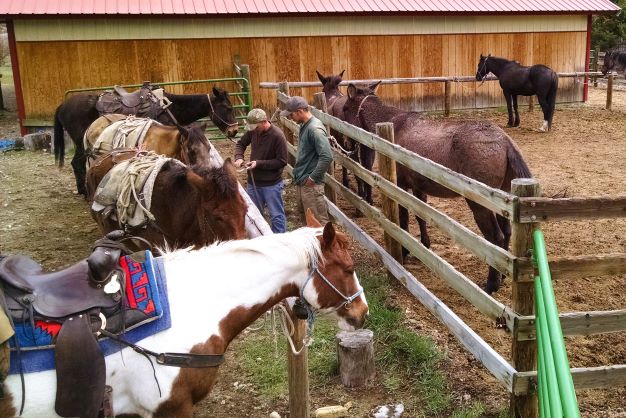
“You’ll have a hard time thinking about how that should be tied when you’re on the downhill side of a string of stock on a bad trail in steep mountains. Stock gets twitchy if you stand around too long, so quit fiddlin’ with that knot and tie it!”
It was immediately apparent that some students would be able to handle the coarse and unexpected pressure and some would not. Ron circled over his students like a hawk, saw everything and struck quickly, and I understood why he was demanding. Being a backcountry packer in the Frank Church Wilderness was a dangerous job in a dangerous place and most of the students didn’t fully understand that fact when they signed on for the school.
For many of the students, the occupation seemed a gritty, almost romantic throw-back to adventurous days gone by. Many came for the glory of guiding; to become the honoured primal hero who guided hunters and fed his tribe. But Ron had been packing for 20 years and knew what the job required. He taught us that backcountry packing could be raw and unforgiving. The danger inherent in managing big animals tied together on small trails in steep hills demanded that a packer be able to deal with stressful situations. He was going to test us under stress. And Ron’s ability to create stress was a thing to behold.
Perfect is Good Enough
Over and over, we practiced until the knot-tying process was committed to muscle memory. We’d practice hitching boxes and mantied loads to the stock, then stringing a couple head together. Different knots for different applications, always working with thousand pound animals. Then we’d saddle a riding horse and lead the short string around the area. Step-by-step, we learned the old ways.

The next morning, I was early in the kitchen. Ron came in right behind me.
“You don’t have to boil new coffee. Just heat that up from yesterday.”
I turned the knob on the gas stove and watched the flame closely to make sure it worked right.
“And how WAS yesterday?” he asked as he put the dishes away.
“A lot. Yesterday was a lot,” I replied. “Like drinkin’ from a fire hose. And you got Ryan shakin’ like a dog shittin’ peach pits.”
Hard Task Master
He chuckled and left two coffee cups on the counter. We were about the same age and, while I accepted him as my mentor, we enjoyed a peer-to-peer relationship. I always called him “Sir” and respected his authority as my boss, but we were too much alike to ignore the opportunity for friendship. He looked up at me over the top of his small, wire-framed, auto-tint glasses.
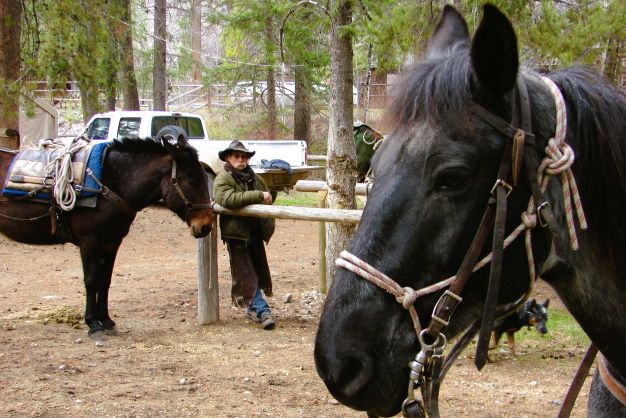
“He better buck up, buttercup. Today won’t be any better.” Ron loved playing the hard taskmaster. “The beatings will continue until morale improves. We’re leaving in nine days for Simplot and we’ve got a lot to learn between now and then. A backcountry packer that rattles easy ain’t gonna make it out here anyway.”
He looked down to pour coffee and said, “And you need to let go of needing reasons for everything we do.”
Like Frankie my brother, Ron was direct with his communication. I worked on being a good student but it had been a long time since I served in that role. I asked too many questions and I knew it; not ‘how’ questions, but ‘why’ questions. Working as Ron’s backcountry apprentice was a new experience for me. I had been in engineering roles for decades, was analytical in my approach by nature, and my busy brain tried to put together the Big Picture… but the school work required I do as I was instructed. My job was tactical, not strategic. Plainly said, Ron was telling me to keep my ears open and mouth shut.
Tough Transition
“Duly noted.”
“Does that piss you off?”
“Not hardly,” I smiled with a half a shake of my head. “It’s part of the bigger program.”
“Good. That’s what I like about Marines; they’re good at taking orders. Go get the stock while Karla gets breakfast together. I’m going to pretend that you know what you’re doing from now on, so act like you’ve done this before.”
He sipped his coffee and the steam fogged up his glasses. He looked up at me as they cleared.
“One more thing. You need to mix it up with that stock, Taylor. In the morning or evening, whenever you can, invest your time and get to know them. I’m serious; a backcountry packer spends a lot of time alone with his stock and, sooner or later, all hell is going to break loose. Everyone’s got to find their own way of working with those animals. I know it spooks ya’, so get in there ‘til you’re comfortable.”
Making the Grade
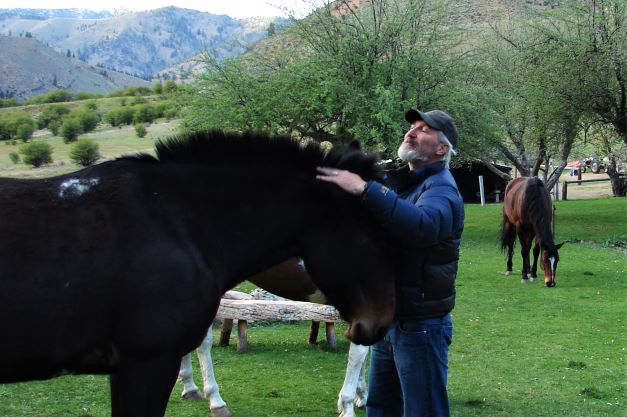
The next few days faded into one another as we prepared for our trip to Simplot. We constantly worked with horses and mules, wrangled and saddled them, and rode them every day. I learned how to use a manti (pronounced ‘man-tee’), the Spanish word for a tarp or piece of canvas used to cover and protect cargo. I learned to tie basket hitches and barrel hitches and diamond hitches on top. My hands hardened and my fingers split as I practiced my new trade, and I received one-on-one training all through each day. It was saturation training in one of the oldest of trades and I was having too much fun to be tired.
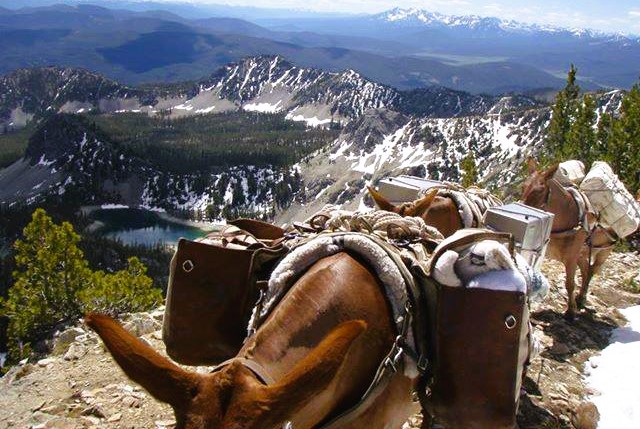
Another thing I learned during Guide/Packer School was that most packers ‘wash out’. They quit while training or during their first year. The ones that lasted long enough to file a tax return on their earnings were few and far between. Ron could only name a couple of former students that still worked as backcountry packers. Only Ryan and I were going to Simplot, and Ryan made it clear that he came to school to be a guide. He would not likely work as a packer. And that was good news to me; it meant that there was plenty of work for someone willing and able to do the job.
It was a good part of the book to review.